Exploring the Cosmic Power of Radiation: Balancing Risks and Rewards
- dstreet422
- Apr 2
- 3 min read
Updated: Apr 10
Radiation surrounds us every day, yet many people only associate it with danger or science fiction. The truth is more complex. Radiation has both harmful and beneficial effects, shaping our world in profound ways. Understanding what radiation is, how it interacts with matter, and its many uses helps us appreciate its dual nature. This article explores the science behind radiation, its risks, and its valuable contributions to medicine, technology, and society.
What Is Radiation?
Radiation is energy that travels through space or matter in the form of waves or particles. It includes a broad spectrum ranging from visible light to X-rays and gamma rays. Radiation can be ionizing or non-ionizing. Ionizing radiation carries enough energy to remove tightly bound electrons from atoms, creating ions. This process can damage molecules and cells, which is why ionizing radiation is often linked to health risks.
Cosmic Radiation and Levels Outside Earth’s Atmosphere
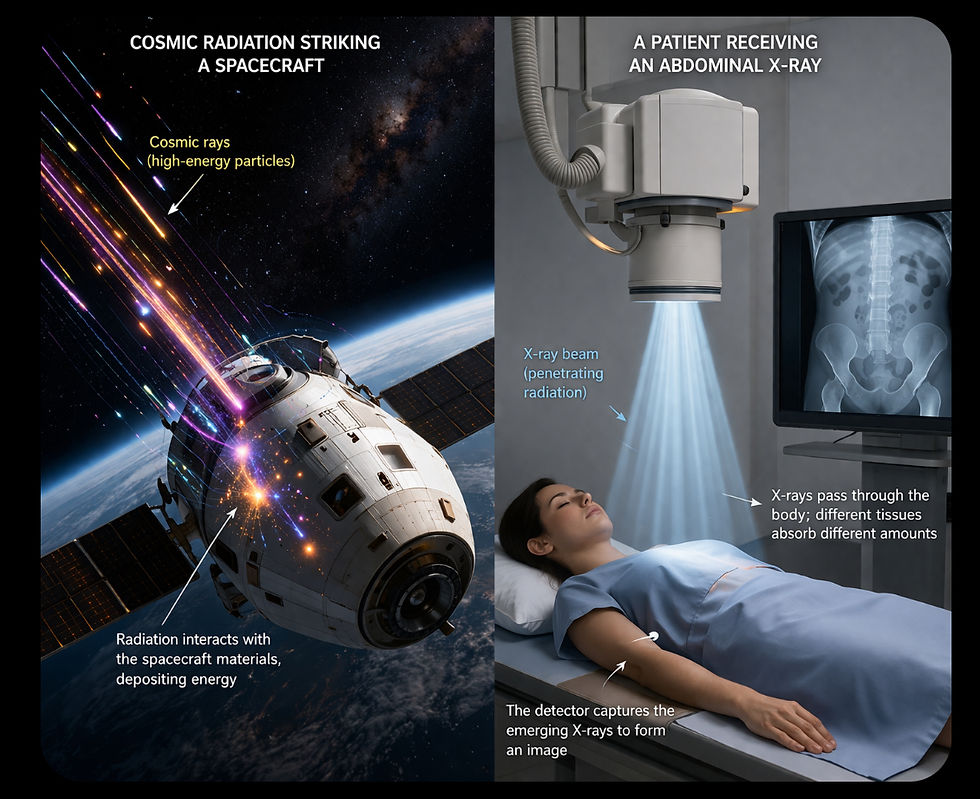
Cosmic radiation comes from outer space and the sun. It consists mainly of high-energy particles like protons and atomic nuclei. Earth's atmosphere and magnetic field shield us from most cosmic radiation, but astronauts and high-altitude pilots face higher exposure.
Outside Earth's atmosphere, radiation levels increase dramatically. For example, astronauts aboard the International Space Station receive about 10 times more radiation than people on the ground. This exposure includes galactic cosmic rays and solar particle events, which can penetrate spacecraft and human tissue.
How Radiation Affects Matter on a Molecular Level
Radiation interacts with matter primarily through photons or particles striking atoms. When a photon hits an electron in an atom, it can transfer enough energy to knock the electron out of its orbit. This process is called ionization. Ionization disrupts the normal structure of molecules, potentially damaging DNA and other critical cellular components.
This damage does not always show immediate effects. Radiation-induced changes accumulate over time, which means health problems like no As cancer or tissue damage may take years or decades to appear after exposure.
The Long-Term Effects of Radiation Exposure
Radiation damage often develops slowly. Cells can repair some damage, but repeated or intense exposure overwhelms repair mechanisms. This leads to mutations, cell death, or uncontrolled cell growth (cancer).
The latency period between exposure and symptoms makes it challenging to link radiation to health issues directly. This delay emphasizes the importance of monitoring and limiting exposure, especially in environments with elevated radiation levels.

Health Benefits of Radiation
Despite its risks, radiation has many positive uses, especially in medicine. One of the most important benefits is the ability to image inside the body without surgery. Techniques like X-rays, CT scans, and PET scans use controlled radiation doses to create detailed images of bones, organs, and tissues. This non-invasive imaging helps diagnose diseases, guide treatments, and monitor recovery.
Radiation therapy also uses targeted ionizing radiation to kill cancer cells while sparing healthy tissue. This treatment has saved countless lives and continues to improve with advances in technology.
Five Positive Uses of Radiation in Society Today
Medical Imaging
X-rays and CT scans reveal internal injuries and diseases without surgery.
Cancer Treatment
Radiation therapy targets tumors to destroy cancer cells.
Sterilization
Radiation sterilizes medical equipment and food, reducing infection and spoilage.
Energy Production
Nuclear power plants generate electricity with low greenhouse gas emissions.
Scientific Research
Radiation helps study materials, biological processes, and space phenomena.
The Importance of Teaching Radiation Principles to Young People
Understanding radiation is crucial for the next generation. As technology advances, radiation will play an even larger role in healthcare, energy, and space exploration. Educating young people about radiation's science and safety prepares them to use it responsibly and innovate new applications.
Awareness also helps reduce fear and misinformation. When people understand how radiation works and its benefits, they can make informed decisions about exposure and support policies that balance safety with progress.
Radiation in War and Weapons
Radiation has a darker side in warfare. Nuclear weapons release massive amounts of ionizing radiation, causing immediate destruction and long-term environmental harm. The bombings of Hiroshima and Nagasaki showed the devastating effects of radiation on human health and ecosystems.
Radiation is also used in smaller-scale weapons like depleted uranium munitions, which can contaminate battlefields. The threat of nuclear war and radiation exposure remains a global concern, highlighting the need for disarmament and strict controls.

Comments