Bioenergetics: Power at the Cellular Level
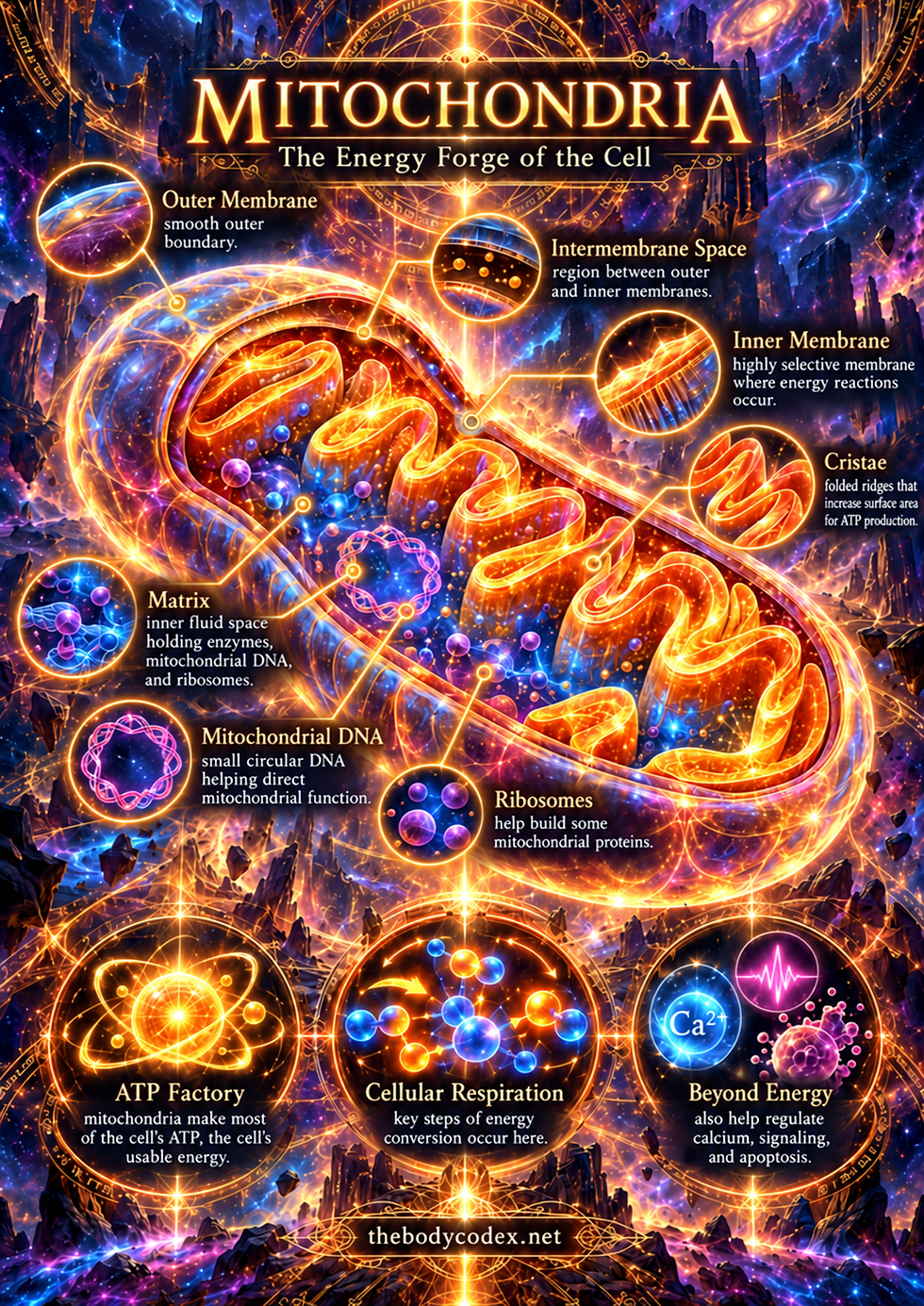
Mitochondria: The Sacred Fire Within the Cell
Deep inside nearly every cell of the human body burns a microscopic furnace.
It has no flame, no smoke, no sound—yet without it, thought would fade, muscles would fall silent, and life itself would lose its power.
This tiny structure is the mitochondrion.
It is where oxygen, nutrients, chemistry, and energy meet—transforming the raw materials of existence into the power that keeps us alive.
⚡ ATP — The Currency of Life
At the center of mitochondrial purpose is ATP: adenosine triphosphate.
ATP is the body's primary form of usable cellular energy.
Every heartbeat, every muscle contraction, every electrical signal traveling through the nervous system, and every conscious thought depends upon cells continually producing and using ATP.
Think of ATP as tiny packets of biological power.
The mitochondria manufacture these packets constantly—transforming the energy stored in food into energy the body can actually use.
🟠 The Outer Membrane — The Boundary
The outer membrane surrounds the mitochondrion like a protective shell.
It separates the mitochondrial world from the rest of the cell while allowing certain molecules to enter and leave.
Every powerful system needs a boundary.
Even at the microscopic level, life creates order by deciding what belongs inside and what must remain outside.
✨ The Intermembrane Space — The Energy Chamber
Between the outer and inner membranes lies the intermembrane space.
During cellular respiration, hydrogen ions accumulate here, creating an electrical and chemical gradient.
It is almost like energy gathering behind a cosmic dam—waiting to be released.
That stored potential eventually helps drive the machinery that produces ATP.
🔥 The Inner Membrane — Where Energy Awakens
The inner mitochondrial membrane is one of the most important energy-producing surfaces in the human body.
Embedded within it are proteins involved in the electron transport chain and ATP production.
Here, electrons move through molecular pathways, hydrogen ions are transported, and chemical energy is transformed.
At this microscopic frontier, matter becomes usable power.
🌊 Cristae — The Folds of Power
The inner membrane folds inward to create structures called cristae.
These folds dramatically increase the available surface area for energy-producing reactions.
More folds mean more room for the molecular machinery that helps generate ATP.
The mitochondrion does not simply contain energy machinery—it builds an entire landscape designed to maximize it.
🌌 The Matrix — The Inner World
Inside the inner membrane lies the mitochondrial matrix.
This fluid-filled environment contains enzymes involved in metabolism, along with mitochondrial ribosomes and mitochondrial DNA.
Important steps in extracting energy from nutrients take place here.
The matrix is like an ancient laboratory hidden inside the cell—constantly processing molecules to keep the greater organism alive.
🧬 Mitochondrial DNA — A Genetic Echo
Unlike most structures inside our cells, mitochondria contain their own small circles of DNA.
Mitochondrial DNA carries instructions for making some of the proteins mitochondria need.
It is a remarkable biological inheritance and one of the clues supporting the idea that mitochondria originated from ancient bacteria that entered into a partnership with ancestral cells billions of years ago.
That ancient partnership still lives inside us today.
🔹 Ribosomes — Builders Within the Powerhouse
Mitochondria also contain their own ribosomes.
Ribosomes help assemble proteins from amino acids.
These mitochondrial ribosomes produce some of the proteins required for mitochondrial function.
Even inside the cell's energy center, there are smaller machines building the machines that sustain life.
🧠 Mitochondria and Consciousness
The connection between mitochondria and consciousness becomes especially powerful inside the brain.
Neurons require enormous amounts of energy.
They must maintain electrical differences across their membranes, move ions, recycle neurotransmitters, communicate with other neurons, and constantly restore themselves after firing.
All of this requires ATP.
Without mitochondrial energy, neurons cannot maintain the electrical activity necessary for normal brain function.
Memory, attention, perception, emotion, and awareness all depend on functioning biological networks—and those networks depend heavily upon energy supplied by mitochondria.
Science has not established that mitochondria themselves create consciousness.
But they are deeply involved in maintaining the living brain capable of producing our conscious experience.
🌠 The Fire Beneath Awareness
There is something extraordinary about realizing that consciousness depends upon processes taking place far beneath the level of our awareness.
While we contemplate the universe, remember childhood, experience love, solve problems, or simply watch the sunrise, trillions of mitochondria are quietly converting oxygen and nutrients into energy.
They ask for no recognition.
They simply continue their ancient work.
From the microscopic folds of the cristae to the electrical storms of the brain, life is a continuous transformation of energy.
Perhaps this is one of the great lessons written inside the Body Codex:
Before there can be thought, there must be energy.Before there can be awareness, there must be life.And deep within life burns the silent fire of the mitochondria.


Comments